There is a version of this story playing out inside almost every enterprise right now.
A team builds an AI agent. It works beautifully in the demo. It navigates the workflow cleanly, calls the right tools, produces coherent outputs. The stakeholders are impressed. Budget is approved. The agent moves toward production.
And then it falls apart.
Not dramatically but usually slowly. The agent starts producing inconsistent outputs. It mishandles edge cases that never showed up in testing. It calls a legacy API and gets back a response it doesn't know how to handle. A version upgrade somewhere breaks a tool schema. The outputs look plausible but are subtly wrong in ways that only become visible weeks later, after they've already propagated downstream.
The team patches and re-patches. Eventually someone says the words nobody wanted to hear: "Maybe it's not ready for production yet."
This is not a rare failure mode. Only 12% of enterprise AI agent initiatives reach production deployment. The average cost of a failed project is $340,000 in direct engineering spend, not counting opportunity cost or organisational credibility damage.
And almost none of these failures are caused by the model.
The Demo Works. Production Doesn't. Here Is Why.
When AI agents fail in production, it's rarely because the underlying model is "not smart enough." Modern LLMs are already competent at language, intent recognition, and basic reasoning. In controlled demos, that intelligence is more than enough. The real gap shows up after deployment.
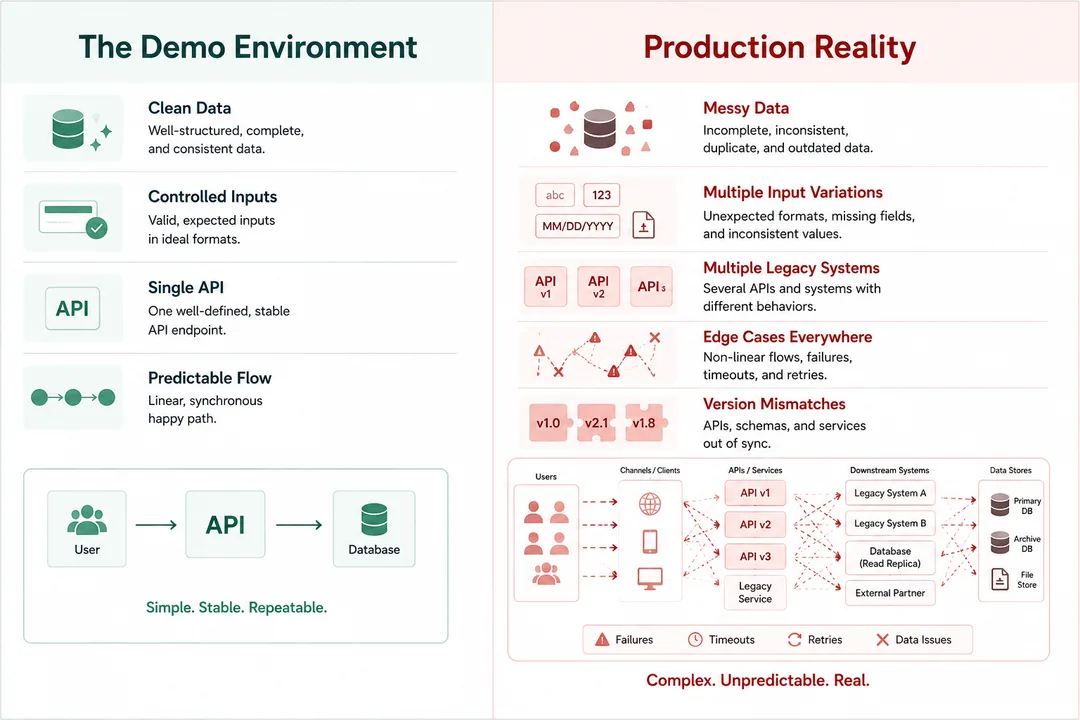
The gap exists because demos are built on clean data, predictable inputs, and a controlled environment that doesn't exist in the real world. Production is the opposite of all three.
Agentic AI pilots look deceptively successful. A small team connects an AI to a few APIs, tests it on clean data, and watches it autonomously execute workflows. In a controlled pilot environment, the agent works. But the moment you flip the switch to production, the environment changes entirely.
Real production data is messy. Real users behave unpredictably. Real legacy systems have rate limits, authentication quirks, undocumented behaviours, and inconsistencies that only surface under actual load. The gap between the documented behaviour of an API and its actual behaviour in production is where most agents quietly die.
The Infrastructure That Everyone Skips
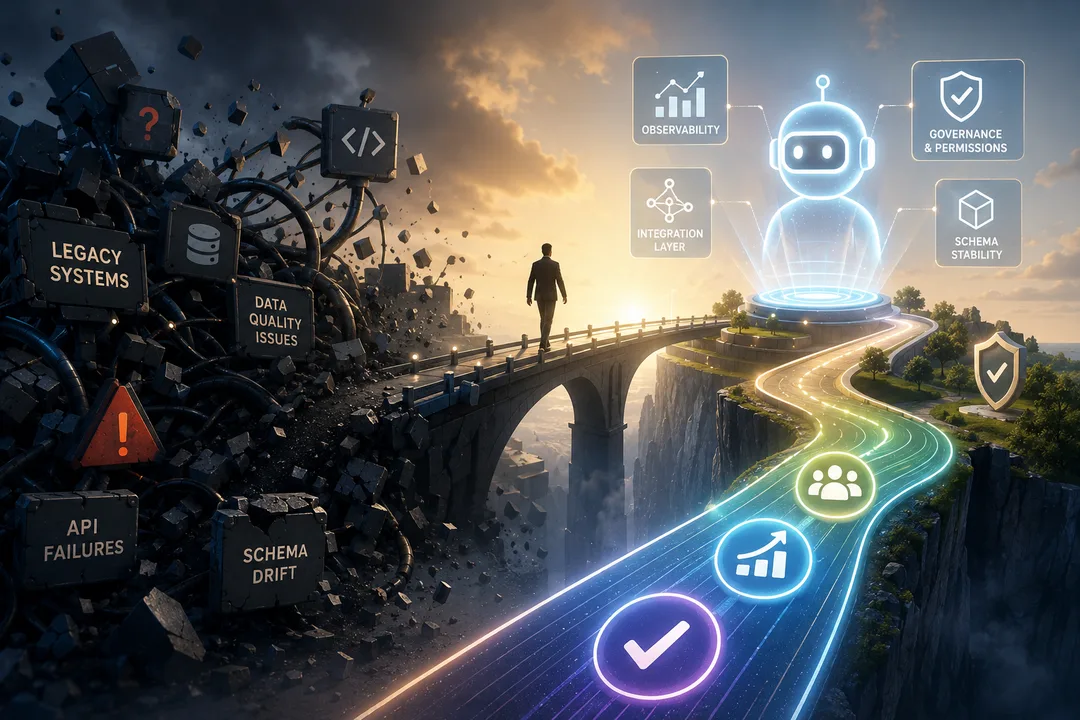
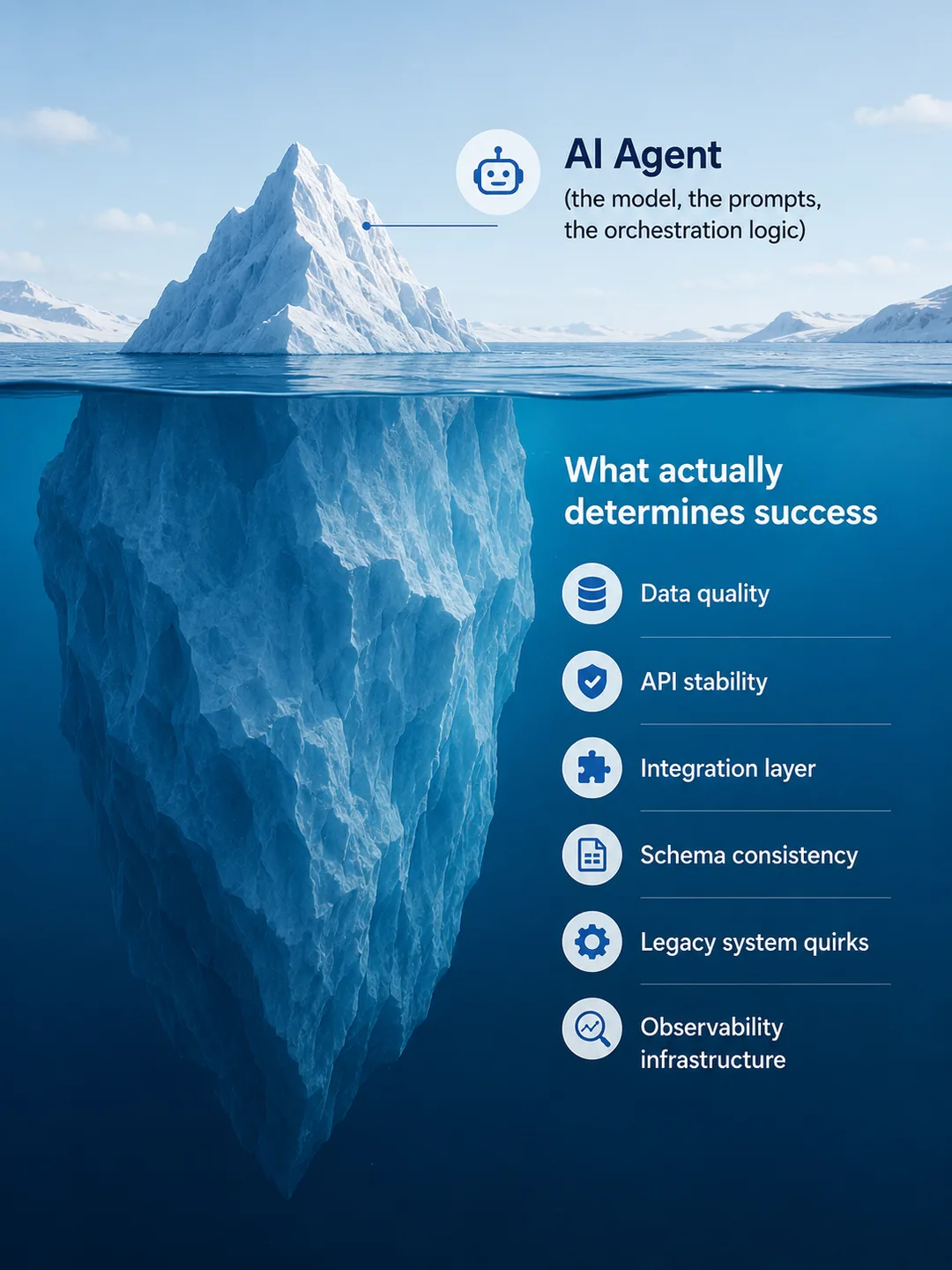
Enterprise AI agents aren't failing because the models are bad. They're failing because organisations are trying to operate them like traditional software, without the infrastructure, governance, and integration layers that agentic AI actually requires.
Here is what that infrastructure looks like in practice, and why teams consistently underestimate it.
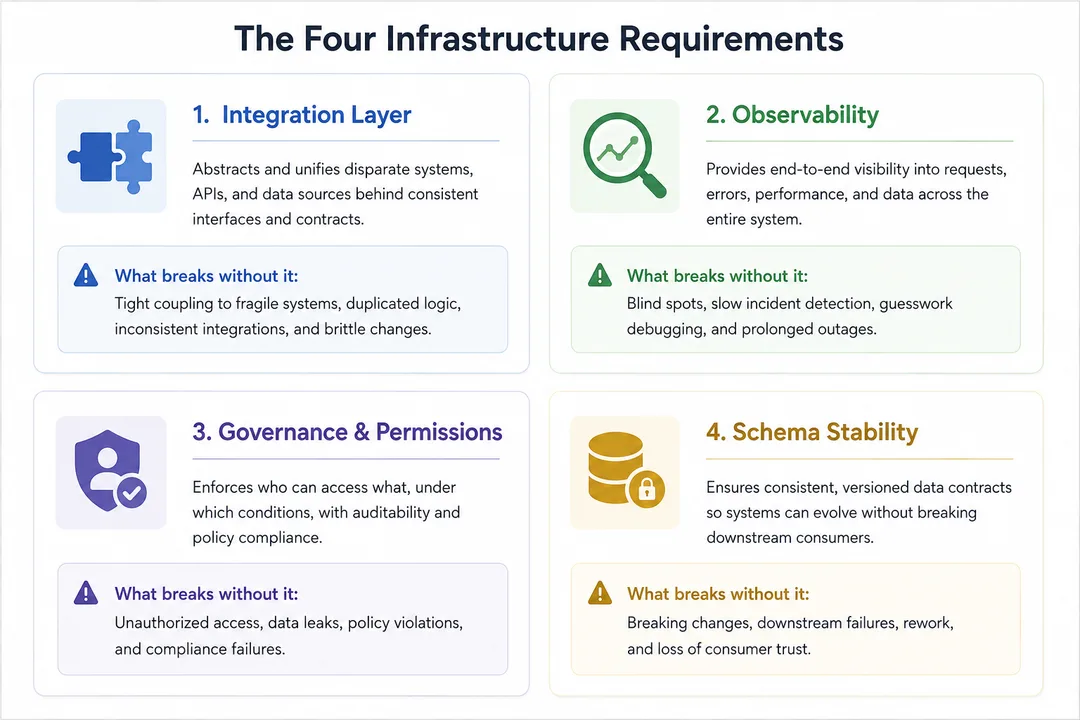
The integration layer. An agent that worked in your pilot was probably connected to one or two clean APIs you controlled. Production means connecting to your actual enterprise systems: the ERP that was built in 2011, the CRM with three different authentication schemes depending on which module you're calling, the legacy database that returns nulls in fields that are supposed to be required. Enterprise systems were not designed to be called by AI agents. They have rate limits, authentication quirks, data format inconsistencies, and undocumented behaviours that only surface under production load. Teams estimate integration work based on API documentation, which describes ideal behaviour. Production integration requires handling the gap between documented and actual behaviour.
Observability. The agents delivering production value in 2026 share three properties. None of them are about model quality. Observable behaviour is one of them. The agents that survive production are the ones where every decision is logged, every tool call is traceable, and every failure is diagnosable without guesswork. Most pilot agents have none of this. When something goes wrong in production, the team has no way to understand what happened or why.
Governance and permissions. Governance is not a feature you add at the end. It is an architectural decision that shapes every component from the beginning. Define permission boundaries, approval gates, and audit logging before writing the first line of agent code. An agent that can take actions across multiple enterprise systems without a defined permission model is not a production agent. It is a liability.
Schema stability. This one is underappreciated until it destroys a production deployment. In February 2026, n8n users upgrading from v2.4.7 to v2.6.3 found that a core component for AI agent workflows began generating invalid JSON schemas. Enterprise-licensed production workflows stopped working entirely. The only fix was rolling back the version. The same failure pattern emerged simultaneously across FlowiseAI, Zed IDE, and the OpenAI Agents SDK. Schema drift, where a version upgrade changes how tool schemas are generated and breaks compatibility with LLM providers, is a production failure mode that pilot environments never surface.
The Compounding Problem Nobody Models
AI agents show a 63% variation in execution paths for identical inputs, meaning traditional unit tests cannot validate non-deterministic behaviour. Traditional DevOps was built for deterministic systems where identical inputs yield identical outputs.
This is a fundamental shift that most engineering teams have not fully absorbed. The testing and validation approaches that work for traditional software do not work for agentic systems, because agentic systems are not deterministic.
In multi-agent systems, compound reliability issues multiply quickly. A system with 10 agents at 95% individual reliability results in only 60% overall system reliability.
Think about what that means in practice. You build an agent that you are 95% confident will execute any given step correctly. That is a high bar. Most production software aspires to that. But chain ten of those steps together, and your overall system reliability has already dropped to 60%. Add error recovery logic and retry mechanisms, and you might recover some of that. But you will never get back to where you started without building infrastructure that most teams have not planned for.
This gap forces teams to build six months of custom infrastructure for observability and governance before a single user can access the agent. The teams that discover this mid-project have already burned most of their budget on the pilot. The teams that plan for it from the start ship.
The Legacy System Problem Is Real and Specific
There is a pattern we see consistently in enterprise AI agent projects that get stuck. The agent works fine against the systems that were built to be integrated with. It falls apart against the systems that weren't.
Most enterprise stacks include a generation of systems that predate modern API design. These systems expose data through SOAP endpoints, flat file exports, COBOL outputs, or direct database queries that were never designed for external consumption. They have data quality issues that were manageable when humans were in the loop, because humans could recognise and correct them. An agent cannot.
Production traffic surfaces the reality: stale embeddings, inconsistent chunking strategies, retrieval latency that breaks real-time SLAs, and hallucinations that undermine user trust within days.
The agent is not hallucinating because the model is bad. It is hallucinating because the data it is retrieving is inconsistent, stale, or structured in a way that makes it difficult to reason about. The model is doing its best with what it is given.
This is why the foundation matters as much as the model. An agent built on top of clean, well-structured, accessible data with stable APIs connecting it to the systems it needs to act on will outperform a more sophisticated agent built on top of messy infrastructure, every single time.
Three Patterns That Actually Reach Production
Not every enterprise AI agent initiative is failing. There are consistent patterns in the ones that ship.
Bounded scope from day one. The agent handles one domain, with a defined tool set, and explicitly refuses tasks outside that boundary. The support agent handles tier-1 tickets. It doesn't touch billing. It doesn't access the admin panel. The boundary is what makes autonomous deployment safe.
The agents that fail are almost always the agents that were scoped too broadly. "An agent that can handle everything in our customer service workflow" sounds like a powerful goal. In practice, it means the agent has undefined permissions, connects to systems it doesn't fully understand, and produces inconsistent outputs when it encounters edge cases that nobody anticipated. Start narrower than feels necessary. Expand after the narrow version is working reliably.
Production as the goal from the beginning, not the end. The 88% treat production as something that happens after the pilot succeeds. The 12% treat production as the goal that shapes every decision from day one.
This means thinking about observability before you think about features. It means designing the integration layer for the messy real-world systems, not the clean test environment. It means defining what governance and permission boundaries look like before the agent has any permissions at all. None of this is glamorous work. It is the work that makes everything else possible.
Incremental deployment over big-bang launch. The agent that ships to 5% of users first, with full logging and a clear escalation path when it encounters something it can't handle, is the agent that reaches 100% of users six months later. The agent that launches to everyone on day one is the agent that gets pulled two weeks later after a high-visibility failure.
What This Means for Your Stack
The agents that are working in production in 2026 are not the ones running on the best models. They are the ones running on the best foundations.
The model is the last part of the problem. The first questions are: what systems does this agent need to connect to, and are those systems ready to be connected to? Is the data it needs accessible, clean, and structured in a way that the agent can reason about? Does the integration layer handle failure gracefully? Is there a permission model that defines what the agent can and cannot do? Is every action observable and debuggable?
If the answer to any of those questions is no, the agent will fail in production regardless of which model you choose.
The companies that are winning with agentic AI right now are not the ones that moved fastest to production. They are the ones that moved most carefully, understanding that the foundation had to be right before the agent could be trusted.
At Roro, we help enterprise teams build that foundation. Not by rebuilding everything from scratch, but by modernising the specific parts of the stack that are blocking AI from working reliably, and building the integration layer that lets agents operate safely on top of existing systems.
If your AI agent project is stuck between demo and production, this is where to start.
Roro is a product innovation studio that has helped companies including L'Oréal, Precision Pro Golf, Luxer One, Eyrus, and Hypelist build and integrate AI, mobile, and connected experiences since 2017.
Frequently Asked Questions
1. Why do AI agents work in demos but fail in production?
Demo environments use clean, controlled data and predictable inputs. Production exposes agents to messy real-world data, legacy system inconsistencies, edge cases, and infrastructure issues that never appear in testing. The model is usually not the problem. The environment is.
2. What is the most common reason enterprise AI agents fail?
Missing infrastructure is the most consistent root cause: no observability layer, no governance or permission model, no integration layer designed for real legacy system behaviour. Teams invest heavily in the model and the prompt design, and underinvest in everything that makes those things usable in production.
3. How do you test an AI agent before deploying to production?
Traditional unit tests are insufficient because agents are non-deterministic. Testing should include behavioural evaluation across a wide range of realistic inputs, adversarial inputs designed to surface edge cases, latency testing under realistic load, and failure mode testing where integrated systems behave unexpectedly. Shadow deployment, where the agent runs alongside humans without taking action, is one of the most effective validation approaches.
4. What does a production-ready AI agent actually look like?
It has a bounded, well-defined scope. Every action it takes is logged and traceable. It degrades gracefully when integrated systems are unavailable. It has a defined permission model that limits what it can do. It has a human escalation path for cases it cannot handle confidently. And it was deployed incrementally, with monitoring in place before it touched real users.
5. How long does it take to get an AI agent to production?
With the right foundation in place, a well-scoped agent can reach initial production deployment in 8 to 12 weeks. The foundation work, data audit, integration layer design, observability setup, and governance model, typically takes 3 to 4 weeks of that. Teams that skip the foundation and go straight to building the agent almost always spend more total time, because they end up doing the foundation work reactively after failures surface in production.
6. Do we need to modernise our legacy systems before deploying AI agents?
Not entirely. You need to modernise the specific parts that the agent depends on. If the agent needs to read from a legacy database and write to a modern CRM, you need a clean integration layer for those two systems, not a full modernisation of your entire stack. Targeted, incremental modernisation of the blocking components is almost always the right approach.